
Telecom Infrastructure
Owning the network changes what a business can build on top of it. This is the capability behind VoxSun — carrier-grade cloud telecom infrastructure, and why it matters for companies whose products depend on voice and connectivity.
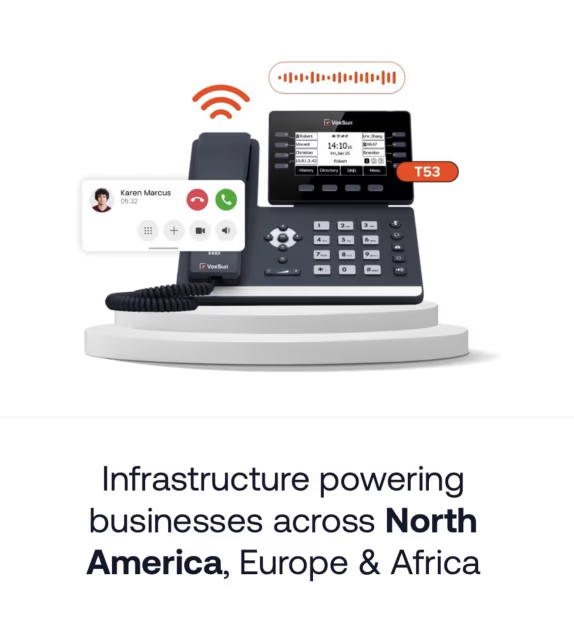
Owning the network versus renting it
There is a meaningful difference between a company that operates telecom infrastructure and one that resells access to someone else's. Resellers inherit their upstream provider's routing decisions, quality ceilings, margin structure and roadmap. Operators do not.
For any business where voice is part of the product rather than an accessory — contact platforms, AI voice applications, automated outreach — that difference compounds. Call quality and latency stop being something you file a ticket about and become something you engineer.
This is the reasoning behind building VoxSun as a carrier from the start rather than as a layer on top of one.
What businesses use it for
The infrastructure supports business communication systems, voice application delivery, and the connectivity layer beneath automation platforms. In practice that spans companies replacing legacy phone systems, product teams embedding voice into their own software, and sales organizations running high-volume automated outreach.
My core experience is in telecom, AI, communications and sports representation, but the infrastructure work applies to any business where communication volume is high enough that the underlying network becomes a cost and quality problem.
- Replacing legacy or on-premise business phone systems
- Embedding voice into an existing software product
- High-volume outbound and automated follow-up
- AI voice applications needing predictable latency
- TODO: add two or three anonymized deployment examples with scale indicators — seats, call volume, or countries covered
Infrastructure as the foundation for automation
Sales automation is the clearest illustration. An AI platform that analyzes calls and triggers follow-ups is only as reliable as the voice layer underneath it. Running both means the automation and the network can be designed together instead of negotiated across a vendor boundary.
That is exactly the relationship between VoxSun and BoostMyDeal, and it is the reason the two are described separately here — one is the company and the network, the other is what gets built on it.
TODO: state whether telecom infrastructure is sold as a standalone engagement, and if so what the commercial model is — per seat, per minute, or project-based
Frequently Asked Questions
- What is VoxSun?
- VoxSun is the cloud telecom infrastructure company I launched in 2010. It powers communication systems, AI voice applications, and business automation platforms for companies across North America and Europe.
- What makes VoxSun different?
- Most companies in this space are AI tools layered on someone else's network. VoxSun is the network — a carrier-grade telecom operator, not a reseller. That's what lets BoostMyDeal run AI sales automation on infrastructure I actually control, instead of renting it.
- What industries do you advise?
- My core experience is in telecom, AI, communications, and sports representation — but the principles behind my work apply to all types of businesses. If you're building something and need execution-focused strategy, that's where I can help.
Related
The company behind the network, the automation layer built on it, and the framework that shapes how both are taken to market.